Intro to Mendoza
Where is it? Tucked away in the foothills of the Andes, about 1,000 km (600 miles) west of Buenos Aires, lies Mendoza. Mendoza is perhaps the most famous wine region in Argentina, and happens to be relatively easy to get to if you’re already in Buenos Aires.
Mendoza is perhaps the most famous wine region in Argentina – it’s known for its high-quality Malbecs, but there is so much more to discover in this region. In addition to Malbec, the region is also known for producing Cabernet Sauvignon and Syrah grapes, but the real hidden gem may be the Cabernet Franc or the Chardonnay, for white wine lovers.
With over 1,500 wineries, Mendoza offers a variety of wine tasting experiences for visitors. The region boasts a stunning landscape with the Andes mountains in the background, making it a popular tourist destination. There are a few distinct regions within Mendoza, that all offer something different. The two I visited were Lujan de Cuyo and Valle de Uco. The third major one is the Maipu Valley.
Understanding the history of the region will help inform where you want to go.
The region has a lot of foreign influence – Michel Rolland and Clos de Los Siete are two names you’ll hear thrown around a lot. Clos de Los Siete is 850 hectares (2,100 acres) of vines at the foot of the Andes Mountains, in the Uco Valley near Mendoza. It’s comprised of 4 bodegas (read: wineries) run by 4 Bordeaux families (it used to be 7 seperate bodegas, hence siete) Together, they produce 1 single wine named “Clos de los Siete”, blended by Michel Rolland, the originator of the project. You can read more about it here!
If you need a break from wine tasting:
Hiking, Eating and Spa Days!
Because you are in the Andes, there is no shortage of hiking. I booked this airbnb experience, which included a full asada meal with a local family, and it was one of the best meals we had the entire time. There are hundreds of hiking trails in the area, and a lot of companies to help with logistics.
We also went to Termas Cachueta, which has massages and treatments if you book in advance, otherwise you can use the day spa for $20-30, and use all of the natural springs to relax after a few days of hiking and drinking.
Food – Mendoza is a fairly large city so you shouldn’t have any trouble finding good food. We went to a lovely Peruvian restaurant Sabores del Peru recommended by our airbnb host. We had a few different kinds of ceviche (we were tired of meat at that point!) and an arroz con mariscos, and a few pisco sours.
Logistics
- When to go? Being in the southern hemisphere, summer and winter are flipped. I was there in early March, just before their harvest, and it was hot, but not unbearable. Being in the mountains, it does get chilly at night, so as my mother would say – bring a light jacket! I’d recommend either March or October for weather and activities. Harvest usually starts early March, and there’s a festival in the city to celebrate it, but the dates change each year.
- Getting there – I went to Mendoza while I was living in Buenos Aires, and by far the easiest way to get there is to fly. Mendoza does have an international airport, but you can’t fly direct from the US or Europe. I’d recommend flying in and out of Buenos Aires or Santiago, and spend a few days in either city. A round trip flight to Mendoza from Buenos Aires or Santiago costs around $50 per person. On domestic flights in Argentina, they don’t care about liquids, so you can carry on up to a case of wine! I didn’t know this going in so unfortunately I didn’t buy wine on this trip. Not sure about to/from Chile.
Pro tip: If you are based in Buenos Aires, you can buy your ticket in cash from a local travel agent (I used Almundo) and you’ll receive about a 10% discount. If you have time to spare, or just really hate flying, you can also take the bus. Be warned, it’s a 14 hour endeavor (a little shorter from Santiago), but the seats are almost lie- flat, and a first class ticket will run you about $75
You CAN drive – but coming from Chile, you have to drive across the Andes, which may be beautiful, but is not for the faint of heart, and you have to deal with customs. Coming from Buenos Aires, it’s long, and mostly flat – from people I know who have done it, it’s not the most special drive. If you already have a car, go for it, but I wouldn’t rent a car just for this occasion. - How I got around This trip differs the most from my style of wine tourism. Because we booked it 2 weeks before, we didn’t have a ton of planning time. We were also only there for 3 days and I didn’t want to deal with driving (my friend does not drive). We used a private driver recommended by our Airbnb host, gave him a list of wineries we were interested in and let him pick + do the planning for us. With more time (both on the ground and planning) I probably would have driven and been able to make a few different winery appointments.
- Other ways to get around You can drive, bike or bus around. Because of its worldwide fame, the wine tourism industry is pretty well funded in Mendoza, so there is no shortage of ways to travel between wineries.
- Cost of tastings Tastings varied in cost, but expect to pay around $20-$50 depending on the type of tour and breadth of wines you taste. Some tastings are comp’d if you buy a bottle!
Fast facts:
- Mendoza is about 1000km/600 miles from Buenos Aires.
- From Buenos Aires: 2 hour flight and $50-60pp (round trip). Aerolíneas Argentina (SkyTeam) and FlyBondi (think RyanAir) fly a few times a day.
- From Santiago: 1 hour flight, also about $50-60pp.
- You can buy your ticket in cash from a local travel agent in Buenos Aires (I used Almundo) and you’ll receive about a 10% discount.
- Got time to spare? Take the 14 hour bus ride that leaves from (insert here). These buses have angled seats (not quite lie flat, but close!) so if you can sleep anywhere, and are traveling on a tight budget, check out this option (insert link?)
- If you’re hellbent on renting a car, drive from Santiago, not from Buenos Aires, or simply rent one in Mendoza.
- Don’t be surprised if you are feeling a lot of French influence especially in the Uco Valley.
- On domestic flights in Argentina, they don’t care about liquids, so you can carry on up to a case of wine! I didn’t know this going in so unfortunately I didn’t buy wine on this trip. Not sure about to/from Chile.
Wineries
Day 1: Lujan de Cuyo
The Lujan de Cuyo is in the southern part of Mendoza.
Lujan de Cuyo is a region in the southern part of Mendoza known for its stunning landscape, with the Andes mountains providing a picturesque backdrop. The alluvial, clay-rich soils anchored with rounded rocks on the bottom provide excellent drainage, making it an ideal planting ground for Malbec + many of the other grapes grown in the region.
- Achaval Ferrer – They recently bought Quimera, which is a smaller winery but the resources behind Achaval Ferrer have allowed them to produce super high quality wines that are less popular for export, but are exceptional.
- Alta Vista
- This was my least favorite of the day. Felt like a big box winery, despite its rich history as one of the first wineries established in the region. I was not particularly enamored with the wines, although the Cabernet Sauvignon was delicious. The tasting started with a sparkling that was a little sweet, moved into a white blend – Chardonnay, Sauv blanc and a Torrontes that I did not care for (however, I have been hard pressed to find a Torrontes that I like).
- Nieto Salentiner (lunch)
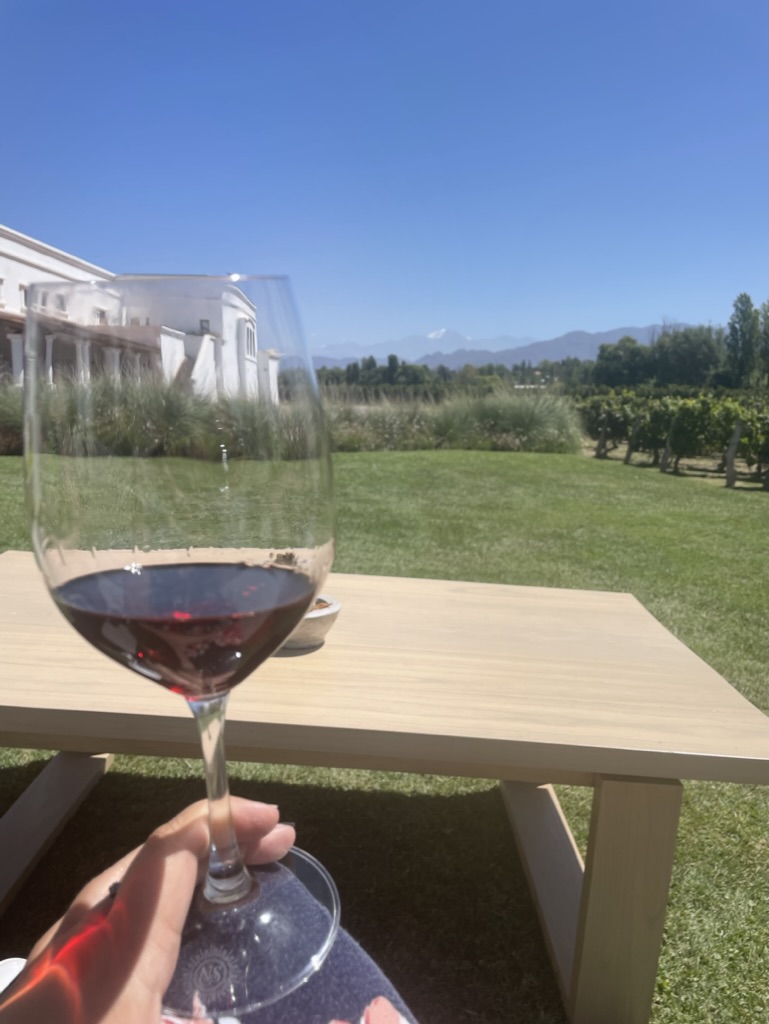
- Stunning location, wines were delicious – I was impressed with their Chardonnay which I typically don’t like.
- Tasted:
Day 2: Uco Valley
- DiamAndes [Clos de los Siete]
- Corazón del Sol – this was the fan favorite (it’s me, I’m the fan)
- The wines here had a freshness that beautifully counterbalanced the weight of the grapes
- Monteviejo [Clos de los Siete] – lunch
 Fine, Wine
Leave a comment